CONCRETE TESTING EQUIPMENTSLatest Guide6 min read
IS 516 Concrete Cube Compressive Strength Test: Complete Laboratory Procedure, Formula & Acceptance Criteria
E
Er. Harsh Mishra
Chief Technical Consultant (Civil QA/QC)
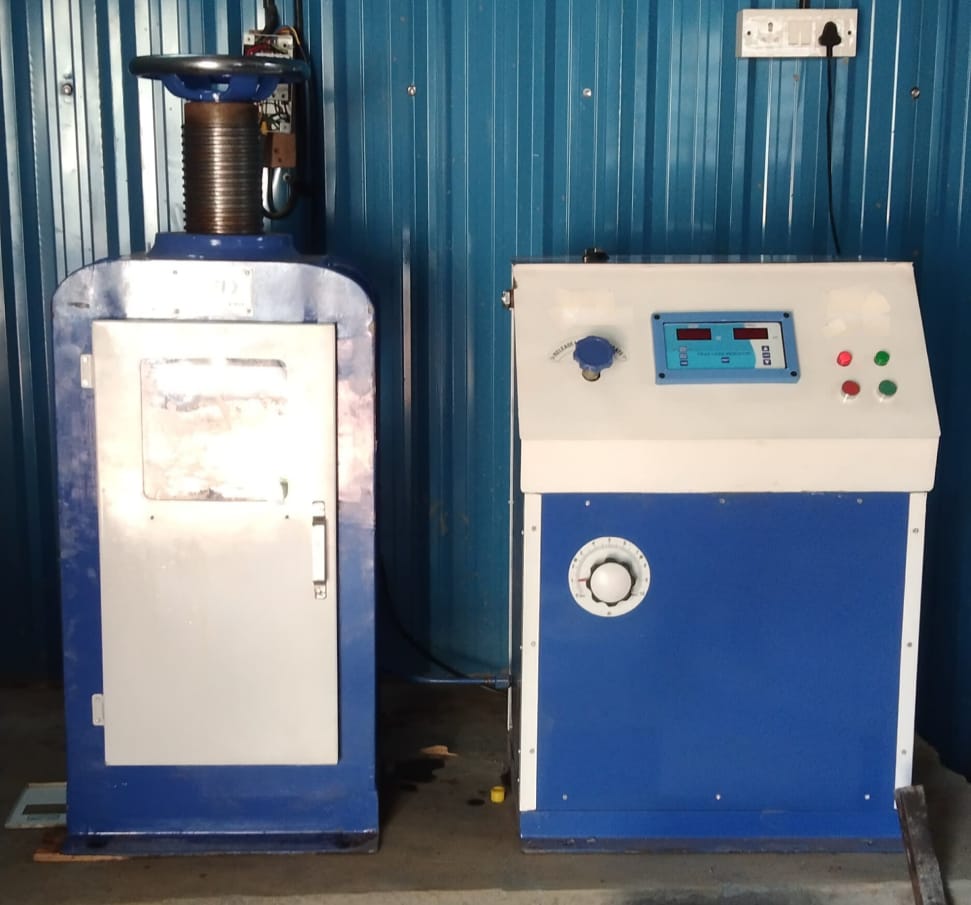
Learn the step-by-step laboratory testing procedure for concrete compressive strength as per IS 516 (1959/2021). Includes sampling, curing, CTM operation, rate of loading calculation, and 7 & 28 days strength benchmarks.
1. Overview & Significance of IS 516
The Compressive Strength of Concrete is the single most critical quality parameter in structural engineering. Whether constructing highways, high-rise towers, or metro viaducts, verifying that hardened concrete achieves its characteristic target strength ($f_{ck}$) is a statutory requirement under IS 516:2021 (Methods of Tests for Strength of Concrete) and IS 456:2000. Concrete cubes ($150\text{ mm} \times 150\text{ mm} \times 150\text{ mm}$) are cast on-site, water-cured at $27 \pm 2^\circ\text{C}$, and crushed at intervals of 7 days and 28 days using a calibrated Compression Testing Machine (CTM).2. Essential Laboratory Apparatus Required
To conduct tests compliant with IS 516 & MoRTH guidelines, your laboratory must have: * Digital / Automatic Compression Testing Machine (2000kN / 3000kN): High stiffness frame with digital pace-rate indicator and peak load hold. * Cast Iron / Heavy Duty Plastic Cube Moulds ($150\text{ mm}$ & $70.6\text{ mm}$): Machined surfaces with base plates conforming to IS 10086. * Tamping Bar: Steel bar $16\text{ mm}$ diameter, $600\text{ mm}$ long with bullet pointed end. * Accelerated Curing Tank: Thermostatically controlled at $27 \pm 2^\circ\text{C}$. * Slump Cone Apparatus: For measuring fresh concrete workability as per IS 1199.3. Moulding & Curing of Cube Specimens
1. Sampling: Fresh concrete is sampled from the transit mixer or batching plant as per IS 1199. 2. Filling Moulds: Place concrete into the mould in 3 equal layers (approx. $50\text{ mm}$ each). 3. Compaction: Tamp each layer 35 strokes using the standard $16\text{ mm}$ tamping rod, ensuring uniform distribution over the cross-section. Alternatively, use a vibrating table for 15–30 seconds. 4. Initial Storage: Store the filled moulds in moist air ($>90\%$ humidity) at $27 \pm 2^\circ\text{C}$ for $24 \pm 1/2\text{ hours}$. 5. Demoulding & Water Curing: Demould the specimens, mark them with date and mix ID, and immediately submerge them in clean water until testing time (7, 14, or 28 days).4. Step-by-Step Testing Procedure on CTM
1. Surface Inspection: Wipe excess moisture from the surface of the cube. Ensure the bearing surfaces are clean and free of loose sand grains. 2. Centering: Place the cube in the ARCL Compression Testing Machine such that the load is applied to opposite sides of the cube as cast, not to the top and bottom. Center the specimen accurately on the lower spherical seated platen. 3. Loading: Adjust the upper platen to touch the specimen without shock. Apply the load continuously at the specified uniform rate until failure. 4. Failure Recording: Note the maximum failure load ($P$) indicated on the digital display unit. Record the type of failure (normal pyramidal crack or shear failure).5. Calculation Formula & Rate of Loading
#Compressive Strength Formula:
$$\text{Compressive Strength } (f_c) = \frac{P}{A} = \frac{\text{Maximum Failure Load } (\text{N})}{\text{Cross-Sectional Area } (\text{mm}^2)}$$ For a standard $150\text{ mm} \times 150\text{ mm}$ cube: $$A = 150 \times 150 = 22,500\text{ mm}^2$$ #Rate of Loading (As per IS 516):
$$\text{Pace Rate} = 140\text{ kg/cm}^2/\text{min} = 14\text{ N/mm}^2/\text{min} \approx 5.25\text{ kN/second}$$6. IS 456 Acceptance Criteria (7 & 28 Days)
* 7 Days Strength: Should achieve approximately $65\% \text{ to } 70\%$ of the 28-day characteristic target strength ($f_{ck}$). * 28 Days Strength: Must meet or exceed $100\%$ of $f_{ck}$ as per Table 2 of IS 456:2000. * Individual Variation: The average strength of three companion cubes represents the sample. The individual variation of any single cube should not exceed $\pm 15\%$ of the average strength.7. Common Testing Mistakes to Avoid
1. Uneven Mould Surfaces: Using deformed or rusted moulds results in point-loading and premature failure. 2. Incorrect Loading Rate: Applying load too fast overestimates concrete strength by $10\text{–}15\%$. Always use a digital pace rate controller. 3. Inadequate Curing Temperature: Water temperature below $20^\circ\text{C}$ severely retards hydration and reduces 7-day strength.Compliant Testing Standards
IS 516:2021IS 456:2000IS 1199:1959ASTM C39