CEMENT TESTING EQUIPMENTSLatest Guide5 min read
IS 4031 Cement Testing: Normal Consistency, Initial & Final Setting Time Using Vicat Apparatus
E
Er. Harsh Mishra
Chief Technical Consultant (Civil QA/QC)
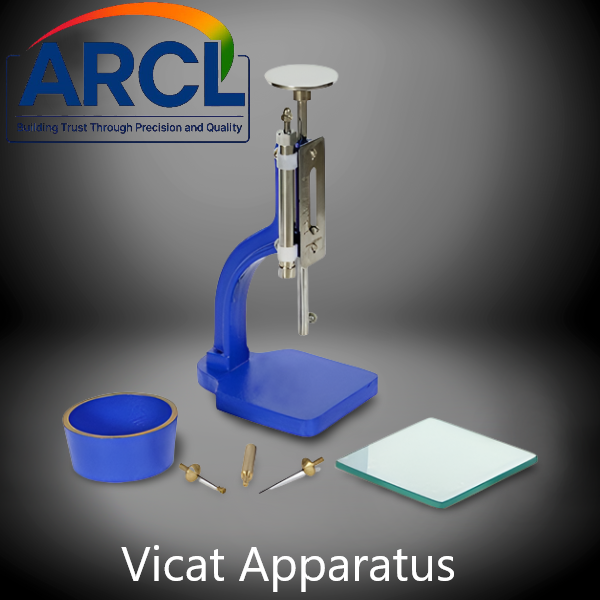
Step-by-step procedure for determining standard consistency (P), initial setting time, and final setting time of OPC/PPC cement under IS 4031 Part 4 & 5 using the standard Vicat apparatus.
1. Understanding Consistency & Setting Times
Before using cement in concrete or mortar, civil engineers must ensure that concrete remains workable long enough to be transported, placed, and compacted (Initial Setting Time), but hardens quickly enough to support structural loads (Final Setting Time). The tests are performed in accordance with IS 4031 (Part 4): 1988 (Standard Consistency) and IS 4031 (Part 5): 1988 (Setting Times).2. Components of Vicat Apparatus
* Vicat Frame with Movable Rod ($300\text{ g}$ total mass): Equipped with an indicator moving over a $0\text{–}50\text{ mm}$ graduated scale. * Vicat Mould: Split ring of $80 \pm 4\text{ mm}$ diameter and $40 \pm 0.2\text{ mm}$ height with glass base plate. * Plunger for Consistency: Polished brass plunger $10\text{ mm}$ diameter, $50\text{ mm}$ long. * Initial Setting Needle: Steel needle $1.13\text{ mm}$ diameter ($1\text{ mm}^2$ area). * Final Setting Needle: Needle with a circular annular cutting ring $5\text{ mm}$ diameter.3. Determination of Standard Consistency (P)
Standard consistency ($P$) is defined as that percentage of water which allows the Vicat plunger ($10\text{ mm}$) to penetrate to a depth of $33\text{ to } 35\text{ mm}$ from the top (i.e. $5\text{ to } 7\text{ mm}$ from the bottom of the mould). 1. Take $400\text{ g}$ of cement and mix with an initial water quantity (e.g. $28\%$ by weight). 2. Fill the Vicat mould within $3\text{ to } 5\text{ minutes}$ of gauging. 3. Lower the $10\text{ mm}$ plunger gently to the surface and release quickly. 4. Record the penetration depth. Repeat with varying water percentages until the $5\text{–}7\text{ mm}$ bottom benchmark is achieved.4. Initial Setting Time Test Procedure
1. Prepare a neat cement paste with $0.85 \times P$ water (where $P$ is standard consistency). 2. Fill the mould and place it under the $1.13\text{ mm}$ Initial Setting Needle. 3. Release the needle periodically into the paste. 4. Initial Setting Time is the elapsed time from when water was first added to cement until the needle fails to pierce the block beyond $5 \pm 0.5\text{ mm}$ from the bottom.5. Final Setting Time Test Procedure
1. Replace the initial needle with the annular ring needle. 2. Release the needle onto the surface of the hardening cement paste. 3. Final Setting Time is the period elapsed when the needle makes an impression on the block, but the circular annular attachment fails to leave an impression.6. IS 269 Specification Limits for OPC & PPC
* Initial Setting Time: Minimum $30\text{ minutes}$ (Allows adequate mixing and placing window). * Final Setting Time: Maximum $600\text{ minutes}$ ($10\text{ hours}$).Compliant Testing Standards
IS 4031 Part 4IS 4031 Part 5IS 269:2015ASTM C191