SOIL TESTING EQUIPMENTSLatest Guide7 min read
IS 2720 (Part 16) CBR Test: Standard Method for Highway Subgrade & Pavement Thickness Design
E
Er. Harsh Mishra
Chief Technical Consultant (Civil QA/QC)
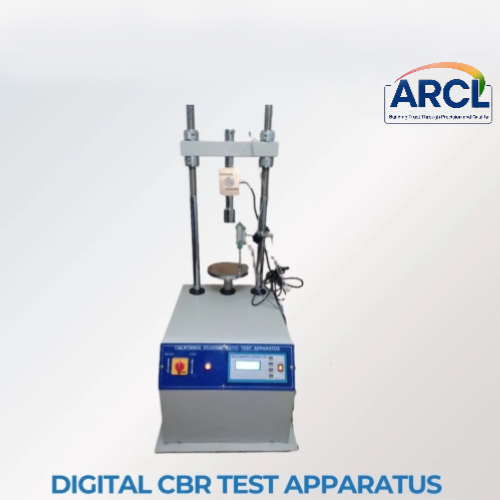
Comprehensive guide to California Bearing Ratio (CBR) testing under IS 2720 Part 16 and IRC 37. Learn how CBR values determine road crust thickness, soaking expansion, and subgrade load-bearing capacity.
1. What is CBR Test and Why is it Mandatory?
The California Bearing Ratio (CBR) test is an empirical penetration test used globally to evaluate the mechanical strength and load-bearing capacity of subgrade soil, sub-base, and base course materials for highway and runway construction. In India, IS 2720 (Part 16): 1987 specifies the laboratory determination of CBR, and the resultant CBR percentage is the single most critical parameter required by IRC 37:2018 (Guidelines for the Design of Flexible Pavements) to calculate the total road thickness (crust).2. Apparatus for IS 2720 Part 16
* Digital / Motorized CBR Testing Machine (50kN): Equipped with a steady penetration rate of $1.25\text{ mm/min}$. * CBR Mould: $150\text{ mm}$ internal diameter, $175\text{ mm}$ height with detachable collar ($50\text{ mm}$) and perforated base plate. * Compaction Rammer: Heavy compaction rammer ($4.89\text{ kg}$, $450\text{ mm}$ drop) conforming to IS 2720 Part 8. * Surcharge Weights: Annular and slotted weights ($2.5\text{ kg}$ each) to simulate pavement overburden load ($5\text{ kg}$ standard). * Penetration Piston: Cylindrical steel piston with a cross-sectional area of $19.35\text{ cm}^2$ ($50\text{ mm}$ diameter). * Dial Gauges: $0.01\text{ mm}$ accuracy for measuring penetration and swell.3. Heavy Compaction & 4-Day Soaking
1. Moisture Conditioning: Prepare soil sample mixed with water at Optimum Moisture Content (OMC) determined via Modified Proctor Test (IS 2720 Part 8). 2. Compaction: Compact soil in the CBR mould in 5 equal layers, giving 56 blows per layer with the $4.89\text{ kg}$ rammer. 3. 4-Day Soaking (Worst Case Scenario): Place a filter paper, perforated plate, and $5\text{ kg}$ surcharge weights on the sample. Submerge the mould in water for 96 hours (4 days) to simulate monsoon saturation. Measure the swell with an expansion tripod.4. Load-Penetration Test Procedure
1. Mount the soaked mould on the platen of the ARCL Digital CBR Testing Machine. 2. Seat the penetration piston with a nominal contact seating load of $4\text{ kg} (40\text{ N})$. 3. Set the penetration gauge and load indicator to zero. 4. Operate the machine at a constant displacement rate of $1.25\text{ mm/minute}$. 5. Record the load at penetrations of $0.5, 1.0, 1.5, 2.0, 2.5, 3.0, 4.0, 5.0, 7.5,$ and $10.0\text{ mm}$.5. CBR Curve Plotting & Standard Load Values
#Standard Crushed Stone Loads (Reference Standard):
* At $2.5\text{ mm}$ Penetration: Standard Load = $1370\text{ kg} = 13.44\text{ kN}$ * At $5.0\text{ mm}$ Penetration: Standard Load = $2055\text{ kg} = 20.15\text{ kN}$ #Formula:
$$\text{CBR } (\%) = \frac{\text{Corrected Test Load at Given Penetration}}{\text{Standard Load for Same Penetration}} \times 100$$ $$\text{CBR}_{2.5} = \frac{P_{2.5}}{13.44\text{ kN}} \times 100 \quad | \quad \text{CBR}_{5.0} = \frac{P_{5.0}}{20.15\text{ kN}} \times 100$$ Generally, $\text{CBR}_{2.5}$ is greater than $\text{CBR}_{5.0}$ and is reported as the CBR value. If $\text{CBR}_{5.0} > \text{CBR}_{2.5}$, repeat the test; if confirmed, report $\text{CBR}_{5.0}$.6. How CBR Determines Road Crust Thickness (IRC 37)
* Subgrade CBR $< 3\%$: Poor soil; requires soil stabilization or subgrade replacement. * Subgrade CBR $5\% \text{ to } 8\%$: Normal subgrade soil suitable for national highways. * Higher CBR = Thinner Pavement Crust: A higher CBR reduces the required thickness of expensive granular sub-base (GSB) and bituminous layers, saving crores of rupees in highway projects.Compliant Testing Standards
IS 2720 Part 16IS 2720 Part 8IRC 37:2018ASTM D1883