Bitumen & Asphalt Testing EquipmentsLatest Guide5 min read
IS 1208 Bitumen Ductility Testing: Standard Method, Apparatus & Temperature Control Guide
E
Er. Harsh Mishra
Chief Technical Consultant (Civil QA/QC)
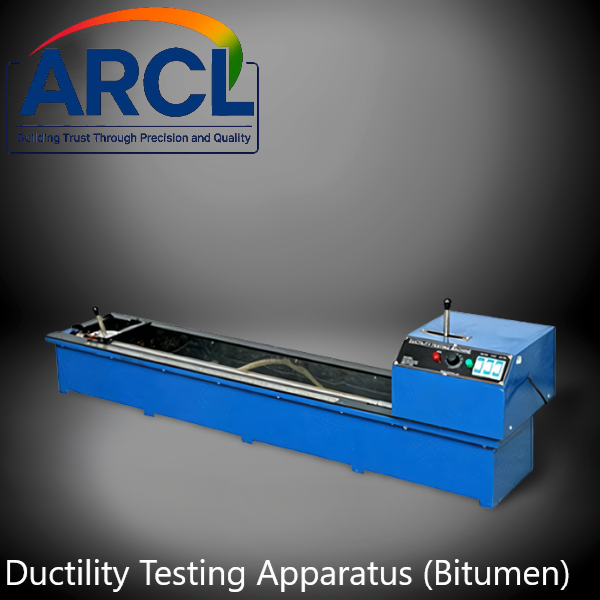
Detailed guide on bitumen ductility testing as per IS 1208:1978 and MoRTH specifications. Discover how elongation distance (cm) before breaking indicates bitumen adhesion and resistance to highway cracking.
1. Why is Bitumen Ductility Crucial for Roads?
Ductility is the property of bitumen that allows it to undergo significant elongation or deformation under tensile stress without breaking. In flexible pavements, traffic loads and temperature fluctuations cause expansion and contraction in the asphalt layer. As per IS 1208:1978 and IS 73:2018, high ductility ensures that bitumen binds aggregate particles securely, preventing fatigue cracking and pothole formation.2. Apparatus & Briquette Mould Dimensions
* Ductility Testing Machine: Motorized water bath capable of maintaining water at $27.0 \pm 0.5^\circ\text{C}$, pulling briquettes at a uniform speed of $50 \pm 2.5\text{ mm/min}$. * Standard Briquette Mould: Brass mould with clip clips and side pieces, creating a minimum cross-section of $10\text{ mm} \times 10\text{ mm}$ ($1\text{ cm}^2$) at the neck. * Constant Temperature Water Bath: Integrated circulating heating/cooling system.3. Specimen Preparation & Trimming
1. Heat the bitumen sample to $75\text{–}100^\circ\text{C}$ above its softening point until completely fluid. 2. Coat the brass mould base plate and interior sides with a release mixture of glycerin and dextrin (1:1 ratio) to prevent sticking. 3. Pour molten bitumen in a thin stream into the mould until slightly overflowing. 4. Allow to cool at room temperature for $30\text{–}40\text{ minutes}$, then submerge in the water bath at $27^\circ\text{C}$ for 30 minutes. 5. Trim excess bitumen flush with the top of the mould using a heated straight-edge knife.4. Test Execution
1. Submerge the trimmed mould in the water bath at $27.0 \pm 0.5^\circ\text{C}$ for $85\text{ to } 95\text{ minutes}$. 2. Mount the mould rings onto the pulling pins of the ARCL Ductility Testing Machine. 3. Remove the side pieces of the mould carefully. 4. Start the pull carriage at the standard rate of $50\text{ mm/minute}$. 5. Observe the thread of bitumen. Record the distance in centimeters (cm) at the exact moment the thread ruptures.5. BIS Acceptance Limits for VG Grades (IS 73:2018)
* VG-10 Bitumen: Minimum $75\text{ cm}$ ductility at $27^\circ\text{C}$ * VG-30 Bitumen (Most Common for Highways): Minimum $40\text{ cm}$ ductility at $27^\circ\text{C}$ * VG-40 Bitumen (Heavy Traffic & Toll Plazas): Minimum $25\text{ cm}$ ductility at $27^\circ\text{C}$Compliant Testing Standards
IS 1208:1978IS 73:2018ASTM D113MoRTH Section 500